When deploying automated copy protection and digital rights management (DRM), engineering teams often face a classic deployment trade-off: speed of execution versus architectural flexibility. Software vendors need a system that can secure intellectual property instantly, yet scale to handle complex, runtime-driven licensing events.
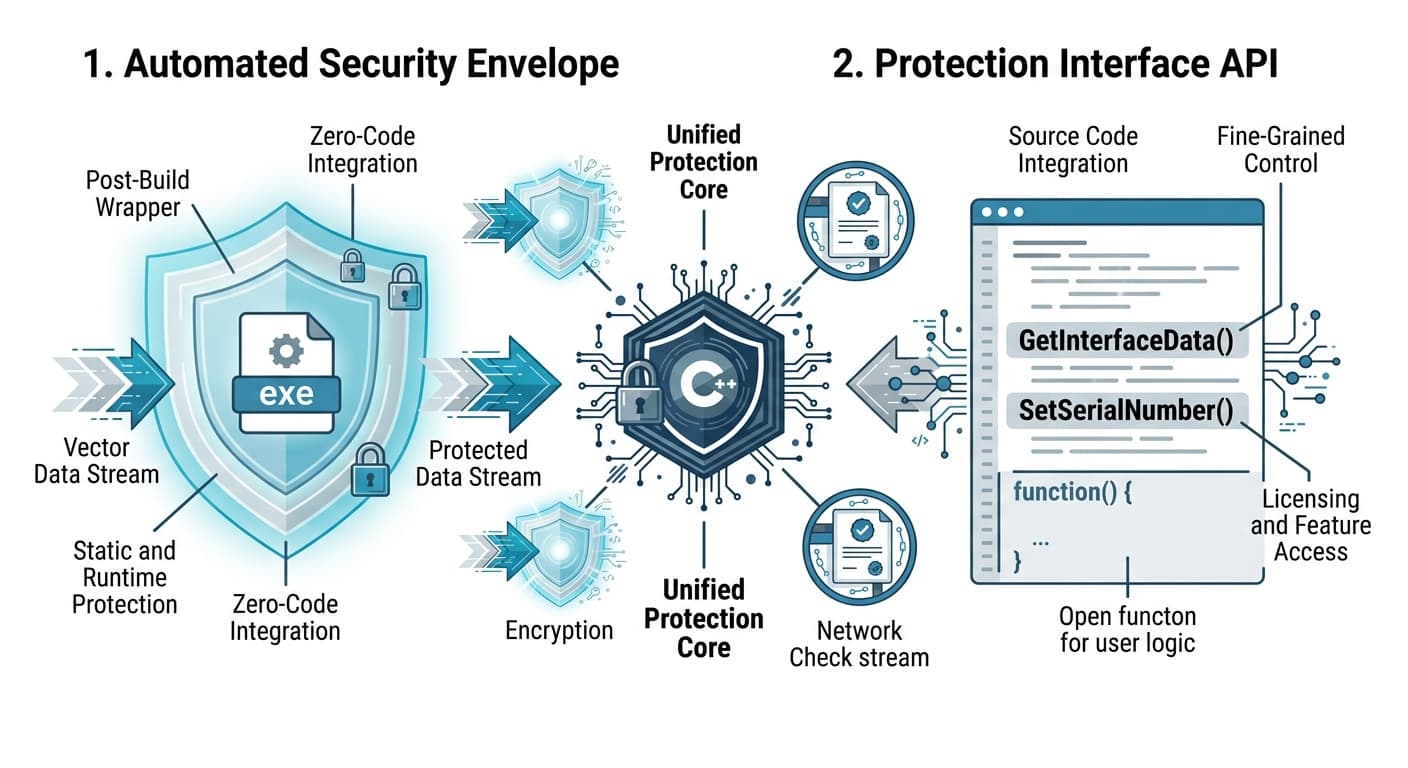
Figure 1: Visual comparison between out-of-the-box binary shell protection and bi-directional runtime API communication.
PC Guard bridges this gap by offering a two-tier deployment architecture. Developers can leverage our automated, zero-code binary wrapper to secure compilation pipelines immediately, or integrate our low-level API layer to dynamically control licensing runtime flows straight from inside their internal application source code.
Out-of-the-Box Envelope
A zero-code binary protective shell injected into compiled PE binaries at the post-build stage. Perfect for instant commercial launches with zero source code refactoring required.
Protection Interface API
A dynamic runtime bridge enabling your code to interact with embedded security layers. Essential for tailored B2B activations, custom telemetry analytics, and in-app upgrades.
1. The Out-of-the-Box Security Envelope
The default implementation workflow utilizes our advanced post-build binary encryption shell. During the protection process, PC Guard wraps your compiled executable (.exe) or library (.dll) inside an encrypted security layer.
On application startup, this protection block gains control first to execute automated anti-debugging heuristics, perform application integrity checks, unpack required data structures, and validate global demo or serial limitations before safely passing execution over to your original code.
Primary Benefits:
- Zero Code Modification: Secure legacy binaries or newly compiled code packages without access to primary source code pipelines.
- Instant Pipeline Automation: Easily inject security parameter payloads straight into your automated CI/CD build scripts using command-line arguments.
- Out-of-the-Box Interfaces: Leverage our built-in hardware activation panels, tracking serial entry grids, and evaluation countdown forms natively.
2. Granular Runtime Control with the Protection Interface
While the binary shell effectively addresses broad copy protection criteria, corporate environments frequently demand tighter communication between the core system layers and the licensing logic. The PC Guard Protection Interface provides this exact capability by creating an interactive dynamic link between your internal logic and our embedded code.
Developers can implement this communication interface at two primary execution levels depending on architectural complexity:
- Standard Protection Interface: Ideal for non-intrusively gathering critical license telemetry. By enabling environment mapping options, your application can instantly query values like
PCGI_SerialNumber, evaluate remaining trial allocations viaPCGI_DemoDaysLeft, or extract structural parameters such as active cloud tokens or Virtual Machine detection flags. - Advanced Protection Interface: Designed for active, bi-directional programmatic control. This framework grants native Windows x86/x64 applications and managed .NET assemblies direct access to low-level compiled functions, letting you override default wrapper UI behaviors with your own custom-branded front-end experiences.
3. Architectural Parity: Core API Functions
Integrating the programmatic interface unlocks an array of specialized runtime functions designed to accommodate custom enterprise software fulfillment models:
| API Function | Practical Business Implementation Case |
|---|---|
GetInterfaceData() | Extracts complete active license parameters at runtime to conditionally adjust application layouts or display tier features based on user clearance. |
SetSerialNumber() | Allows vendors to pass licensing validation payloads silently from an internal enterprise sign-on screen, eliminating native serial prompt grids entirely. |
UnlockApplication() | Processes dynamic activation or evaluation extension code streams directly from a customized, brand-aligned splash frame or terminal UI window. |
TransferLicense() | Empowers end-users to securely migrate their hardware-locked instance seats onto alternative workstations via self-service panels with no support desk friction. |
ValidateWebLicense() | Triggers background, over-the-air validation routines against your central Activation Center (ACEN) server to check subscription lease limits or revoke seats instantly. |
Hybrid Implementation: The Ultimate Best Practice
You do not have to choose one over the other. The most effective security architecture relies on a hybrid approach. Developers use the automated out-of-the-box envelope to achieve maximum binary hardening (anti-tampering, string encryption, import-table scrambling) while leveraging minimal Protection Interface API hooks inside the source code to seamlessly handle silent licensing updates, runtime upgrades, and elegant, cloud-automated SaaS renewals.
Architect Your Security Environment
Whether you require a zero-code licensing wrapper or granular low-level API controls, our suite delivers ironclad protection with absolute structural flexibility. Protect your software assets with zero distribution royalties.