For decades, physical hardware keys (dongles) were considered the gold standard for high-value desktop software protection. Developers building unmanaged Win32 binaries, native Delphi, or C++ applications routinely relied on physical USB tokens to guarantee copy protection. However, in the modern software era, shipping physical hardware introduces immense operational overhead, shipping friction, and support delays.
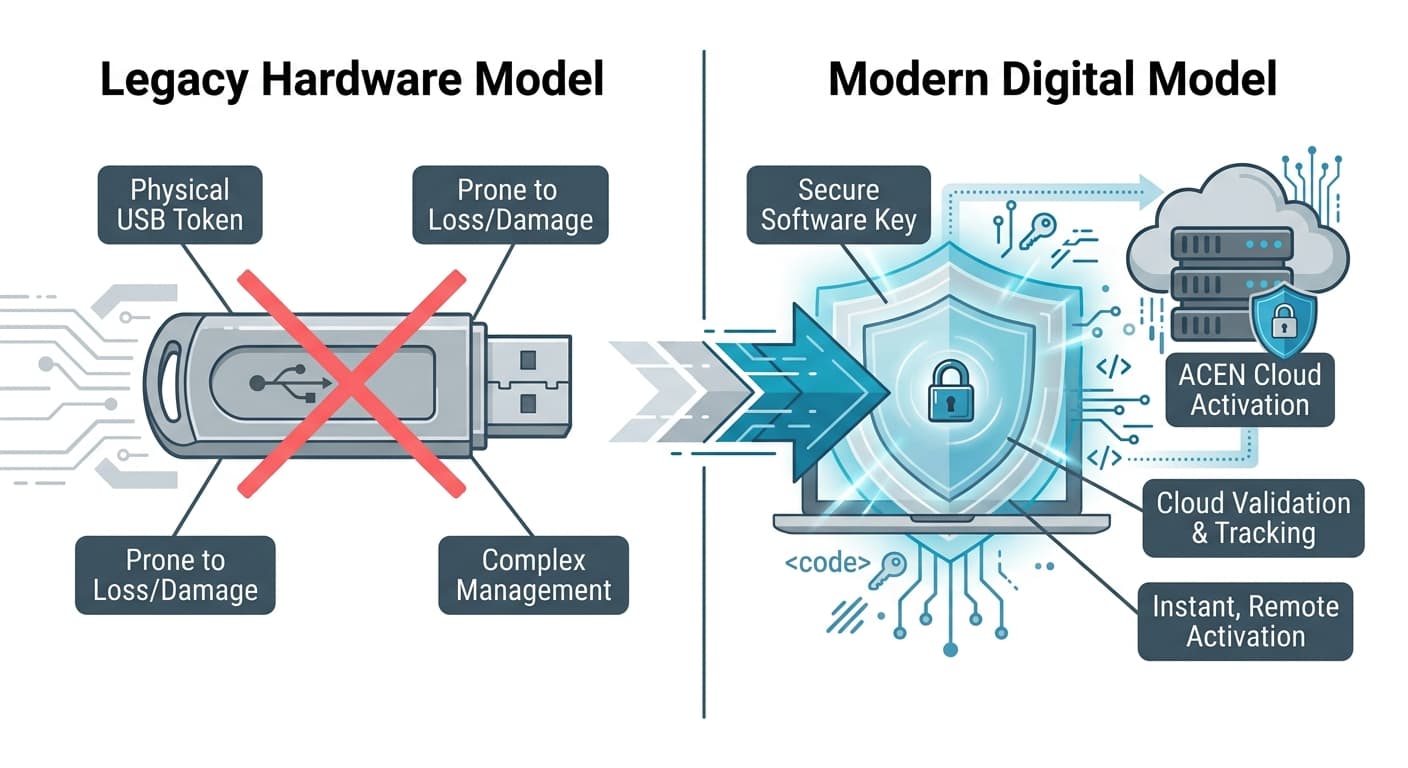
Figure 1: Shifting from high-overhead physical USB tokens to automated, hardware-bound cloud validation.
The transition to software-based machine locking allows developers to completely eliminate fulfillment logistics. By replacing a physical USB stick with a digital, hardware-bound cryptographic wrapper, software publishers achieve identical (or superior) anti-piracy protection while ensuring instant, over-the-air license delivery.
Zero Logistics
Eliminate physical inventory, international customs holds, shipping delays, and the overhead costs of managing hardware tokens.
Instant Delivery
Customers unlock their purchased applications instantly. No more waiting days for a parcel to arrive to clear initialization blocks.
No Broken Hardware
Physical USB ports wear down, and dongles get lost or broken. Digital licenses wipe out hardware support tickets completely.
1. The Mechanics of Software Machine Locking
Many developers hesitate to drop hardware tokens because they fear software-only keys can be easily shared or copied across machines. PC Guard solves this vulnerability through a rigid Machine Locking protocol. Instead of validating against a physical smartcard chip inside a USB port, the protected security envelope samples unique internal hardware and operating system parameters to build a local cryptographic signature.
When your protected application executes on a remote computer, it automatically generates a unique pair of Site and Machine ID (MID) codes. These identifiers are mathematically compiled from up to seven independent system layers, ensuring that the software cannot run if copied to another machine:
- Hardware-Level IDs: Samples permanent factory characteristics including your Central Processing Unit hardware serial (CPU ID), motherboard system BIOS markers, and raw Hard Drive firmware serial numbers (HD ID HW).
- Network Adapter Identifiers: Captures the unique Media Access Control (MAC) hardware address of the active network card profile (NET ID HW).
- Software-Level Markers: Tracks logical parameters such as the active Windows Operating System installation footprint (OS ID) and partitions.
2. Handling System Hardware Upgrades Elegantly
A common flaw in legacy machine-locking utilities was extreme rigidity—if a user upgraded their network card or replaced a secondary hard drive, the system signature would break, locking out legitimate users and causing emergency support calls.
PC Guard implements a highly sophisticated, Flexible Licensing Policy to prevent these false-positive lockouts. Within the deployment project manager, administrators can mark specific hardware metrics as Changeable. If a user modifies their computer configuration, the license remains fully valid as long as the total number of hardware changes stays below your predefined safety threshold. Support agents can also use our built-in Machine ID decoder utility to instantly compare a user's old and new hardware parameters to validate legitimate upgrade requests.
3. Cloud Automation via Activation Center (ACEN)
By combining PC Guard's native envelope wrapping with the Activation Center (ACEN) web server, you achieve a fully hands-free distribution model. You can seamlessly offer automated software trials, process upgrades, and manage seats without picking up a telephone or writing a manual email:
| Licensing Action | Digital Cloud Workflow (Zero Hardware Required) |
|---|---|
| Instant Activation | The client enters a serial key on launch. The protected binary securely relays local Site/MID codes to ACEN via HTTPS, logging the machine fingerprint and unlocking the app instantly. |
| Self-Service Transfers | Users can safely trigger a license removal routine on an old machine. The cancellation token is uploaded to ACEN, immediately freeing up their seat allocation for a new hardware installation. |
| Subscription Control | Instead of replacing physical dongles to extend or renew leases, administrators simply adjust subscription parameters inside the ACEN web panel to update live seats in the background. |
Maintaining Multi-Architecture Protection Parity
Transitioning to digital copy protection does not mean compromising on raw binary defense. PC Guard injects identical anti-debugging layers, import table scrambling, and anti-tamper heuristics regardless of whether you choose to lock your application to a physical workstation hardware footprint or run it across complex environments. Your intellectual property stays entirely safe from reverse engineering, while your sales funnel runs on autopilot.
Eliminate Software Shipping Overhead
Drop expensive hardware dependencies today. Move to secure, automated machine locking and experience global, instant, and royalty-free digital software distribution.