Thursday, May 28, 2026 - 15:29
How to Protect .NET 10 and .NET 11 Applications from Reverse Engineering
With .NET 10 now firmly established as the enterprise standard and the first preview versions of .NET 11 rolling out, Microsoft has delivered incredible runtime optimizations and cloud-native capabilities. However, the core security dilemma remains unchanged: intermediate language (IL) code can be easily decompiled. To prevent software piracy, protect your intellectual property, and secure your revenue streams, implementing a modern, multi-layered security wrapper is a critical requirement for any production-ready commercial application.
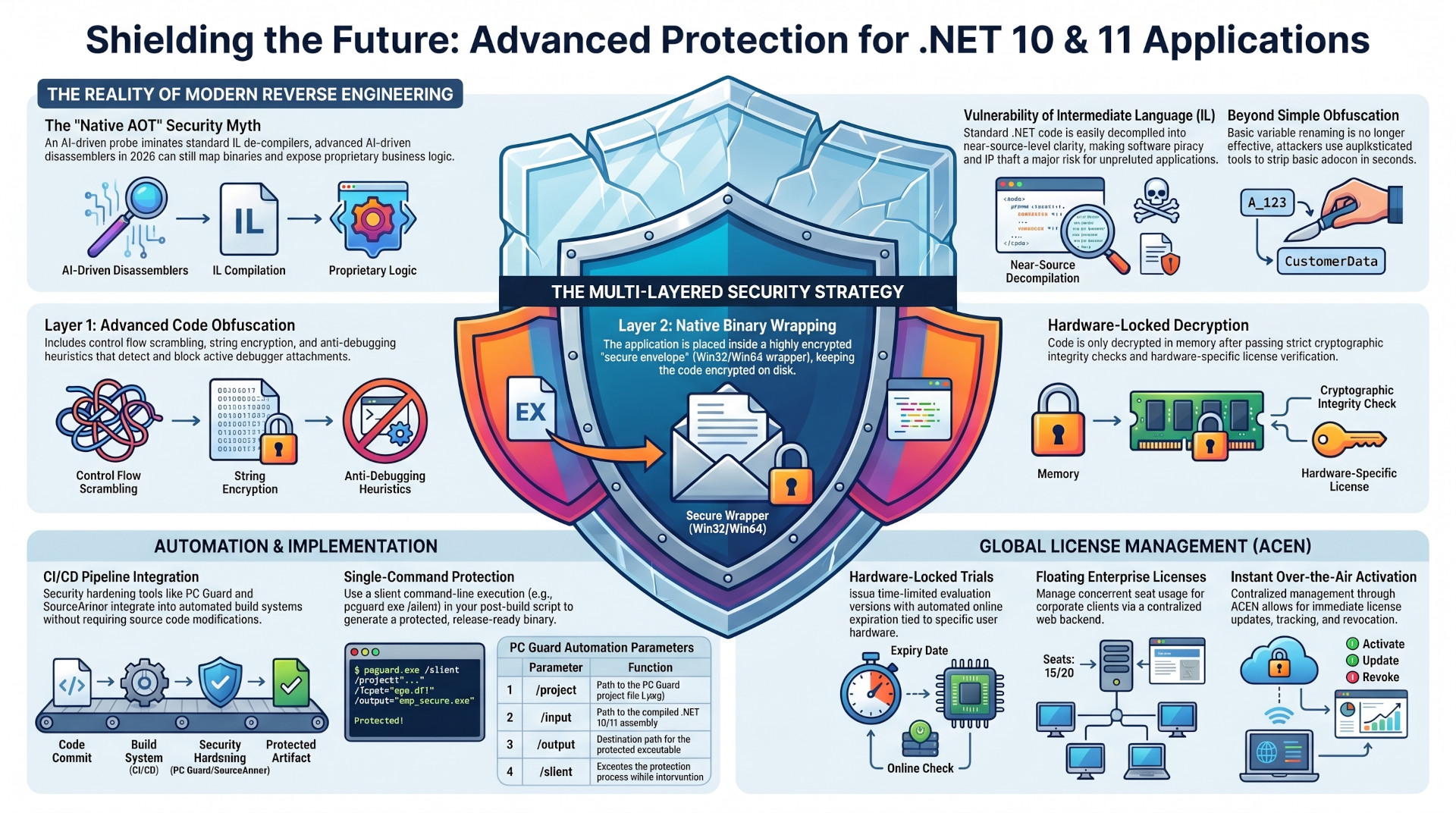
The de-compilation threat in the modern .NET era (Including Native AOT)
Ever since Microsoft introduced robust Native AOT (Ahead-Of-Time) compilation in .NET 7 and .NET 8, and refined it through .NET 9, 10, and 11, many developers falsely assume that their binaries are inherently secure. Because Native AOT compiles C# directly into machine code instead of Intermediate Language (IL), it successfully eliminates standard de-compilers.
However, in 2026, this is no longer enough to deter modern crackers. Advanced AI-driven disassemblers and reverse engineering platforms can easily map out Native AOT binaries, expose exported function names, and reconstruct your proprietary business logic or licensing checks. For legacy applications running on non-AOT pipelines, standard utilities still strip basic obfuscation within seconds. True intellectual property protection requires an external native hardware-locked security wrapper to completely encrypt the executable and shield it from memory dumping and advanced live debugging.
Multi-Layered Protection Strategy for .NET 10 & 11
To thoroughly secure your commercial software products against reverse engineering, you must employ a robust combination of code-level obfuscation and native binary wrapping:
- Advanced Code Obfuscation: Simple renaming of variables is easily bypassed by AI-driven analysis. Advanced software copy protection must include control flow scrambling, string encryption, and anti-debugging heuristics that actively detect when an attacker tries to attach a debugger to your running process. For dedicated .NET code hardening, deploying a specialized .NET obfuscator ensures that your internal application logic remains completely unreadable.
- Native Binary Wrapping (The Secured Envelope): The ultimate defense is injecting your compiled .NET assembly inside a native, highly encrypted secure envelope. This ensures that your code remains completely encrypted on the disk and is only decrypted in memory after passing strict cryptographic integrity and hardware-locked license checks.
Automation: Securing your build pipeline with PC Guard
Hardening your software should not complicate your development cycle or slow down your release schedule. Advanced security tools like PC Guard and SourceArmor are engineered to slot directly into your modern automated build systems without requiring a single modification to your original source code.
Here is how you can easily automate the execution of a secure PC Guard wrapper within your CI/CD deployment script:
# Automating PC Guard security wrapping for a release-ready .NET 10/11 application
pcguard.exe /project:"C:\Sofpro\Projects\DotNet10App.pcg" /input:"C:\Build\Release\net10.0\MyApplication.exe" /output:"C:\Dist\ProtectedApp.exe" /silent
By integrating this single command into your post-build process, your output binary becomes immediately resilient against reverse engineering, unauthorized code modification, and illicit copying on all Windows 11 environments. For specific command-line parameters and integration options, you can review our detailed technical documentation.
Cloud-Based License Management via ACEN
Security is only effective if it pairs with seamless user management. Linking your protected .NET binaries with a centralized web backend like Activation Center (ACEN) allows you to effortlessly issue, track, and revoke licenses globally. You can instantly configure:
- Hardware-Locked Trials: Time-limited evaluation versions with automated online expiration.
- Instant Activation: Over-the-air license updates and seamless key generation for your sales team.
Conclusion: Future-Proof Your Software Protection
As the developer ecosystem moves deeper into the .NET 10 lifecycle and prepares for the upcoming full release of .NET 11, using outdated protection schemes puts your software business at serious risk. Keeping your proprietary source code safe from de-compilation is paramount to maintaining a competitive advantage.
Ready to secure your next release? You can download our free trial version to test enterprise-grade .NET protection firsthand.