Special key pop-up enabled
By default, protected application will display activation dialog on startup. Use this option if you don't want activation dialog to be displayed on each run and let your end user choose when to invoke activation dialog by using specific special key or combination of special keys. Four different special keys (Scroll lock, Caps lock, CTRL and SHIFT) can be combined for this purpose.
| When? | Why? |
|---|---|
| During evaluation period | Display of limitation counters is enabled in demo mode settings. This also allows user to activate application during evaluation period in case of remote protection. Enable Always display activation dialog box option in demo mode settings to force displaying of activation dialog on each run. |
| After evaluation expires | Activation is required (remote protection). |
| After activation | So that end user can manage his license (remove, transfer or extend) depending on enabled license management features. |
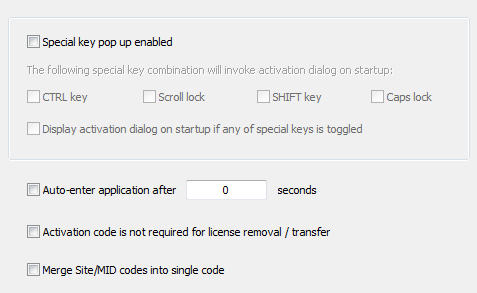
By default, activation dialog will be displayed in case exact keys combination is toggled (for example, ctrl and shift pressed + caps lock toggled). If you want to change this behavior you can select "Display activation dialog if any of selected keys is toggled" option.
Invoking activation dialog via command line
Use -PCG_CL_SHOW (uppercase) command line option for protected application if you need to invoke activation dialog during demo mode or after activation.
Auto-enter application after N seconds
This option will make application startup automatic (after N seconds) in case "Enter application" radio button is enabled on activation dialog. Default status: OFF.
As soon as activation dialog is displayed timer will start. When timer elapses activation dialog will close and application will start.
Activation code is not required for license removal/transfer
If enabled, valid activation code will not be required for license removal and license transfer (via activation dialog). By default, this option is turned off and activation code is required for license removal/transfer. This is to prevent license removal or transfer by unauthorized persons. Default status: OFF.
Merge Site/MID codes into single code
If enabled, Site code and MID code will be merged and displayed as single site-mid code on activation dialog. Default status: OFF.
Merged site-mid code has the following format:
SITE-MID (XXXXXXXX-XXXX-XXXX-XXXX-XXXX)
This option will only affect the way Site/MID codes are displayed on activation dialog and in PC Guard's activation panel. MID code field will be hidden and Site code field will be extended in order to be able to hold merged site-mid code